POI Platform & Event Distribution Hub
2025
Centralized Points-of-Interest system with multi-precision geohash + Redis geospatial cache. The EDH counter-proposal routes change events through Apigee for PDPL filtering, consent validation, attribute redaction, and commercial-terms enforcement.
The problem
The Balady platform is the authoritative source of Points-of-Interest data (merchants, government facilities, citizen-facing landmarks) for Saudi municipalities. Multiple consumers — internal (ArcGIS, Commercial Domain) and external commercial vendors — need timely POI updates. The challenge: citizen-facing locations are personal data under PDPL, and commercial distribution requires consent + commercial-terms enforcement.
The architecture
POI Platform — the canonical store:
- ESRI Geodatabase as the authoritative store
- Multi-precision geohash + Redis geospatial cache for fast radius queries (different precision levels for different use-cases: street radius vs city radius)
- Dedicated approval workflow for changes — submissions land first in a staging store and only approved records are promoted to the authoritative spatial store, keeping the source of truth clean and audited
Event Distribution Hub (EDH) — my counter-proposal for distribution:
Instead of point-to-point integrations, externally bound POI-change events flow through Apigee before reaching any commercial consumer. Apigee applies:
- PDPL filtering — drop or redact fields the consumer is not entitled to
- Consent validation — check the citizen’s outgoing consent flags per consumer
- Attribute redaction — partial fields based on the consumer’s contract
- Commercial-terms enforcement — rate-limit, payment-tier, contract scope
Only after passing all four gates does an external event reach the commercial consumer’s webhook. Internal consumers, by contrast, subscribe to event topics directly over low-latency, replayable streams — the gateway is reserved for the external boundary where compliance and commercial terms must be enforced.
Change events are written to an outbox in the same transaction as the POI change, then relayed for distribution — so if a change persists, its event is guaranteed to publish eventually, even across restarts. No change is silently lost between the store and the distribution boundary.
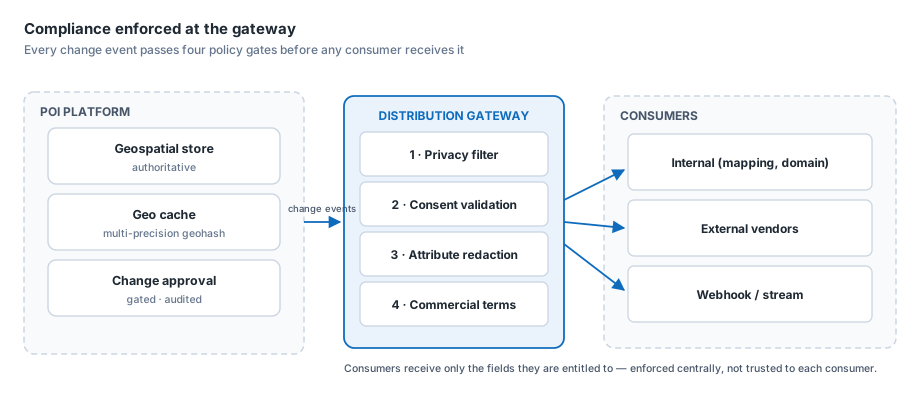
Pattern view — every change event passes four policy gates before any consumer receives it.
Outcome
A defensible commercial-distribution architecture where compliance is enforced at the gateway rather than depending on every consumer to honour the contract.